
Before we begin
Feeding is one of the most exciting times of a baby's first year. But along with that excitement, there are often many questions—perhaps more than any other topic related to infant feeding.
-
When is the best time to start?
-
Is the baby ready yet?
-
What foods are good to start with?
-
How much should he eat? And what should we do if he refuses to try?
Every baby grows at their own pace, but the basic principles of feeding are similar for all. In the following lines, we will look at how the introduction of solid foods supports nutrition, development and a positive attitude towards food. We will also share practical tips that can make this new stage an enjoyable experience for both baby and the whole family.
Why is powering up an important step?
The first year is one of the fastest and most intense periods of growth and development in a human life. During these months, the brain builds millions of new neural connections, muscles strengthen, the digestive system continues to mature, the immune system learns to recognize the world around it, and the baby acquires a host of new motor, cognitive, and social skills. (Hofsten & Rosander, 2018, pp. 73-106)
Nutrition is an important part of this process., but it is only one of many elements. Healthy development also depends on adult care, sufficient sleep, movement, play, opportunities to explore the world, and secure emotional connections with loved ones. Feeding naturally fits into this broader process. It not only provides valuable nutrients, but also gives the baby the opportunity to learn every day through touch, taste, smell, movement, and communication.
Viewed this way, feeding takes on a new meaning. It is not just a time when the baby receives the nutrients it needs, but also an opportunity for different aspects of development to come together and work together.
When a baby's nutritional needs change
During the first six months of life Breast milk or formula provide almost everything needed for normal growth and development of a healthy baby. (Nutrient adequacy of exclusive breastfeeding for the term infant during the first six months of life, nd) They provide energy, high-quality proteins, essential fats, vitamins, minerals and substances that support the immune system – all in a composition that is exceptionally good foradapted to the needs of the infant.
As the baby grows His nutritional needs gradually change.
Around the sixth month, the needs for some nutrients begin to increase. This is especially true for iron, but also for zinc, protein, and additional energy. (Health Supervision Visit, 6 Months, 2026) The reason is the rapid growth rate characteristic of this period. The iron deserves special attention, as it is vital for the transport of oxygen in the body and for normal brain development. Babies are born with iron stores accumulated during pregnancy, but during the second half of the first year, these stores are gradually depleted. (Ziegler et al., 2014, pp. 2023-2034)
Here power supply plays an important role. It helps to meet increasing nutritional needs smoothly through gradual introducing foods rich in valuable substances. At the same time, breast milk or formula milk continues to provide the bulk of a baby's nutrition during the first year.
Understanding this principle helps debunk one of the most common misconceptions about feeding – the goal is not to replace milk as quickly as possible. On the contrary, during this period Milk and solid foods complement each other and each of them plays its own important role in the baby's growth and development.
Eating is a skill that develops
For us adults, eating seems completely natural. For a baby, however, it is a new skill that is learned gradually.
Before a baby can start feeding themselves, they must develop a complex combination of motor, oral, and sensory skills. They gradually learn to move food into their mouth with their tongue, to coordinates chewing and swallowing, to handle different textures safely, and later to drink from a cup and use utensils.
As with turning, crawling, or walking, these Skills develop with practice. The more opportunities a baby has to practice them, the more confident they will be in learning them. That's why weaning is not just a period in which we introduce new foods. It is also a time in which The baby is building skills that he will use throughout his life.
Research shows that gradually moving to more varied textures helps the development of oral motor skills. (Delaney et al., 2025) By trying different textures, your baby learns to use their lips, tongue, and jaw in new ways. This gradually develops the coordination needed for safe eating and prepares them for the variety of textures that will be on the family menu.
New flavors and textures
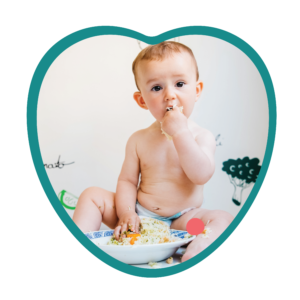
One of the most exciting parts of feeding is the moment when baby begins to discover a completely new a new world of tastes and sensations. Every new food brings something different – taste, aroma, color, temperature or texture. While adults often think of food as a source of nutrients, babies They learn mostly through their senses.
These first encounters with food are of great importance.
Studies show that when babies are exposed to a variety of foods repeatedly and without pressure, they become more accepting of new tastes and textures over time. (Spill et al., 2019) Familiarity makes us feel more at ease, and this is especially true when it comes to eating. This is especially important in the second year, when many children naturally become more wary of unfamiliar foods. This is a normal developmental stage, not a sign that the child is „capricious“ or „picky.“.
Therefore, during the first months of feeding, it is not most important that the baby immediately likes every new food. The opportunity to try it calmly and repeatedly is much more valuable. sees, touches, smells, tastes and gradually get used to it. Every such meeting is part of the learning process.
Digestive and immune system support
Nutrition is also an important step in the development of the digestive system.
As new foods are gradually introduced, your baby begins to receive a greater variety of nutrients, fiber, and natural plant compounds than they would through milk alone. At the same time, the community of beneficial microorganisms that live in the gut, called the gut microbiota, continues to develop. gut microbiome.
The science of the gut microbiome is evolving rapidly, and there is still much to learn. However, research to date suggests that a balanced diet during infancy can support the development of a rich and diverse microbiome. This is important because it is involved in digestion, metabolism, and the normal functioning of the immune system. (McKeen et al., 2019)
During this period it continues to mature and immune system. When a baby is gradually introduced to a variety of foods, including common food allergens at the appropriate time according to current recommendations, the immune system has the opportunity to recognize them as a normal part of the diet.
Although these processes occur quietly and imperceptibly, they remind us that every new food brings much more than a new taste. It gives the body a chance to grow, develop, and adapt to the world around it.
Much more than just eating
Feeding is not just adding new foods to your baby's diet. It is part of a much broader process of growth, learning, and development.
- helps to meet the baby's growing nutritional needs;
- supports developing the skills needed for safe and confident eating;
- introduces the baby with new tastes, aromas and textures;
- gives him the opportunity to explore, learn and gradually become an active participant in family meals;
- supports development of the digestive and immune systems.
What are the signs that a baby is ready to be fed?
Hofsten, C. v. & Rosander, K. (2018). The Development of Sensorimotor Intelligence in Infants. Advances in Child Development and Behavior 55, pp. 73-106. https://doi.org/10.1016/bs.acdb.2018.04.003
(n.d.). Nutrient adequacy of exclusive breastfeeding for the term infant during the first six months of life. https://www.who.int/publications/i/item/9241562110
(February 13, 2026). Health Supervision Visit, 6 Months. American Academy of Pediatrics. https://www.aap.org/en/patient-care/newborn-infant-and-early-childhood-nutrition/newborn-and-infant-health-assessment-and-promotion/health-supervision-visit-6-months/?form=donate
Ziegler, EE, Nelson, SE & Jeter, JM (2014). Iron Stores of Breastfed Infants during the First Year of Life. Nutrients 6(5), pp. 2023-2034. https://doi.org/10.3390/nu6052023
Delaney, AL, Staskiewicz, S., Morris, SE, Smith-Simpson, S. & Goday, PS (2025). A Developmental Texture Framework for Food Texture Progression: Implications for Feeding Development, Oral Motor Skills, and Pediatric Feeding Disorder. Journal of Texture Studies 56(3). https://doi.org/10.1111/jtxs.70026
Spill, MK, Johns, K., Callahan, EH, Shapiro, MJ, Wong, YP, Benjamin-Neelon, SE, Birch, L., Black, MM, Cook, JT, Faith, MS, Mennella, JA & Casavale, KO (2019). Repeated Exposure to Food and Food Acceptability in Infants and Toddlers: A Systematic Review. The American Journal of Clinical Nutrition 109. https://doi.org/10.1093/ajcn/nqy308
McKeen, S., Young, W., Mullaney, J., Fraser, K. & McNabb, WC (2019). Infant Complementary Feeding of Prebiotics for the Microbiome and Immunity. Nutrients 11(2). https://doi.org/10.3390/nu11020364